
An IRS mileage rate calculator helps you figure out your mileage deduction or reimbursement. This tool uses the official IRS standard mileage rates for different types of driving and time periods. If you’re filing your 2026 tax return in 2027, the 2026 mileage rates apply to your deduction. This is especially important because rates can change, even within the same year. Read on to learn how to claim every eligible mile!
IRS Mileage Calculator 2026
Estimate your 2026 mileage deduction or reimbursement. Enter your miles by purpose and when you drove them. Leave unused fields blank.
Track Next Year's Miles Automatically
Don't Have the Miles? Build Them from Google Timeline
Try Now for FreeEstimates use the official 2026 IRS standard mileage rates. The result estimates mileage-based amounts, not your actual tax savings. Deduction eligibility varies by category, and the amounts are not necessarily additive on a tax return. Medical and charitable deductions may be subject to additional restrictions. Moving deductions are limited to qualifying taxpayers. Employer reimbursement policies may differ. View IRS rates.
TL;DR
- Applying for a mileage deduction in the 2027 tax season? Use the IRS mileage calculator to estimate your deduction for 2026, accounting for business, medical, qualifying moving, and charitable trips.
- 2026 has two mileage rates. Business mileage is worth 72.5¢ per mile from January through June and 76¢ from July through December.
- Keep accurate mileage records. Track your trip dates, destinations, purposes, and distances to support your deductions or employer reimbursements.
- MileageWise helps you track new trips automatically and recover missing mileage records using Google Maps Timeline and AI-powered tools. Try automatic mileage tracking free for 14 days!
Table of Contents
How to Calculate Your Mileage Deduction
Calculating your mileage deduction is pretty straightforward once you have the right numbers. The basic idea is to multiply your eligible miles by the correct IRS rate. However, it’s important to use the rate that applies to the specific dates you drove.
The formula looks like this:
Mileage Deduction or Reimbursement = Eligible Miles × Applicable IRS Rate
Let’s look at some direct examples for 2026:
- 1,000 business miles in January-June 2026: 1,000 miles × $0.725 = $725
- 1,000 business miles in July-December 2026: 1,000 miles × $0.76 = $760
- 2,500 business miles split evenly across 2026: (1,250 miles × $0.725) + (1,250 miles × $0.76) = $906.25 + $950 = $1,856.25
Notice how a proper IRS mileage rate calculator needs to ask for specific dates, not just a total annual mileage count. This ensures you apply the correct rate to the correct period.
Rates Used in This Calculator
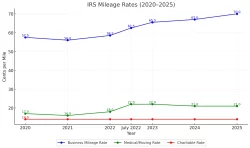
The IRS sets various optional standard mileage rates for different purposes, and these can change. For 2026, the rates even changed mid-year!
Here are the 2026 IRS mileage rates this calculator uses:
| Use | January 1–June 30, 2026 | July 1–December 31, 2026 |
|---|---|---|
| Business or self-employed use | 72.5¢ per mile | 76¢ per mile |
| Medical transportation | 20.5¢ per mile | 23.5¢ per mile |
| Moving for qualifying military purposes | 20.5¢ per mile | 23.5¢ per mile |
| Charitable service | 14¢ per mile | 14¢ per mile |
It’s crucial to understand that these are optional standard mileage rates. You might also choose to calculate your actual vehicle expenses, but that’s a whole different set of rules. For more details on the latest rates, always check the official Standard Mileage Rates page on the IRS website. You can also watch this video to understand what the IRS has to say about standard mileage rates.
Why the IRS Mileage Rate Can Change
The IRS usually updates these rates every year to reflect economic factors like fuel costs. Sometimes, like in 2026, they even make a mid-year adjustment if there are significant changes. That’s why simply entering a total annual mileage figure into an IRS mileage calculator isn’t enough. You need to know the dates your trips occurred to apply the correct rate.
Which IRS Rate Should You Use?
Picking the right rate for your trips is vital for accurate calculations. Here’s a quick guide:
- Business Rate: Use this for eligible business-related travel, including qualifying self-employment trips.
- Medical Rate: Use this for driving to doctor’s appointments, hospitals, or pharmacies for qualifying medical care.
- Moving Rate: This one is specific. It applies to qualifying military moves and certain intelligence community relocations in 2026. Check the IRS moving expense eligibility rules carefully.
- Charitable Rate: Use this when you’re driving for a recognized charitable organization.
Employer Reimbursement: How the Calculation Differs
It’s easy to confuse an IRS deduction with employer mileage reimbursement, but they are different. The IRS mileage rate is primarily a federal benchmark. It helps you calculate deductible vehicle costs and guides certain reimbursement setups. However, it’s not a mandatory rate every employer must pay.
Keep these points separate:
- Tax Deduction: This is what an eligible taxpayer uses, like a self-employed individual, to lower their taxable income using the standard mileage method.
- Employer Reimbursement: This is when your employer pays you for work-related vehicle use. Their policy might match the IRS rate, use a lower rate, a higher rate, or another approved method.
- Tax-Free Reimbursement: Whether this payment is tax-free for you depends on specific rules, including accountable plan requirements.
- Actual-Expense Method: Instead of the standard mileage rate, you can sometimes calculate and deduct the business share of actual costs such as fuel, repairs, insurance, and vehicle depreciation.
When you use a mileage reimbursement calculator, make sure it clearly labels the result. It should say “estimated deduction” or “estimated reimbursement” so you don’t think the IRS is directly paying you.
Can Employees Deduct Mileage on Their Federal Tax Return?
For most employees, unreimbursed business mileage was not deductible on federal tax returns from 2018 through 2025. This restriction was made permanent for most employees beginning in 2026. Certain exceptions still apply, including some categories of employees, and state tax rules may differ.
If your employer reimburses you for mileage under an accountable plan, you generally cannot also deduct that same expense. This prevents you from claiming the same expense twice.
Records the IRS Expects Behind the Number
To back up your mileage claims, the IRS expects solid records. A detailed IRS-compliant mileage log is your best friend here. It helps ensure your mileage tax deduction calculator output is fully supported.
A credible mileage log should include:
- Date of each trip
- Starting location and destination
- Business purpose or other qualifying reason for the trip
- Total miles driven for that trip
- Vehicle used, if you have more than one
- Odometer readings that help substantiate your total annual mileage and business use
- Any associated toll and parking records
A strong log is timely, specific, and consistent. It should align with your calendar, invoices, or appointment records. Separate your business, medical, charitable, and personal miles clearly. Keep these records for the time required by federal, state, and any employer rules. For detailed recordkeeping requirements, see IRS Publication 463, Chapter 5: Recordkeeping.
Using MileageWise to Master Your Mileage Logs and Deductions
Building an IRS-compliant mileage log can feel like a chore, but it doesn’t have to be. MileageWise’s solutions are designed to make mileage tracking easy, accurate, and audit-ready. We help self-employed professionals, small business owners, and gig workers keep reliable mileage records and maximize eligible mileage tax deductions.
Here’s how MileageWise simplifies things:
- Past Mileage Recovery: Recover missing mileage records from Google Timeline, Excel files, or other tracker apps. Complete your log manually or with the AI Wizard using available trip data, if necessary.
- Automatic Mileage Tracking: Keep your records up to date going forward. The MileageWise mobile app records new drives automatically, reducing manual work and the risk of missing trips.
- Audit-Ready Mileage Reports: Review your logs for 70 potential audit red flags and generate detailed reports for tax season, reimbursement, or an audit.
When it comes to something as important as your tax deductions, having a reliable system behind your numbers makes all the difference.
Try MileageWise for free for 14 days. No credit card required!
Automatic Mileage Tracker App


Conclusion: The Smart Way to Track Miles
Calculating your mileage deduction is simple when you know how many eligible miles you drove and which IRS rates apply. With the mid-year rate increase in 2026, tracking your mileage by date is especially important. Use our IRS mileage calculator to estimate your deductions, and let MileageWise help you keep accurate, audit-ready records for tax season.
FAQ
What is an IRS mileage rate calculator?
Also called a mileage deduction calculator, it is a tool that multiplies your eligible miles by the applicable IRS standard mileage rate to estimate a potential tax deduction or reimbursement.
Where can I find the current IRS mileage rate?
The IRS publishes current standard mileage rates on IRS.gov. Just search for “IRS standard mileage rates” and check the year and dates.
Does the calculator handle different rates for business, medical, moving, and charitable miles?
A good mileage calculator, like ours, lets you pick the trip purpose and automatically applies the correct rate.
Are tolls and parking included in the IRS mileage rate?
No. Eligible tolls and parking are separate expenses. Track them separately and keep your receipts.
Should I use the standard mileage rate or actual expenses?
The standard mileage method is simpler. Actual expenses might give a larger deduction if your vehicle costs are high. Compare both and understand the rules before choosing.
What records do I need to support my mileage?
Keep a detailed mileage log. It should show the date, purpose, locations, and miles for each trip, plus receipts for tolls and parking.