IRS Raises 2026 Mileage Rate to 76 Cents per Mile Mid-Year
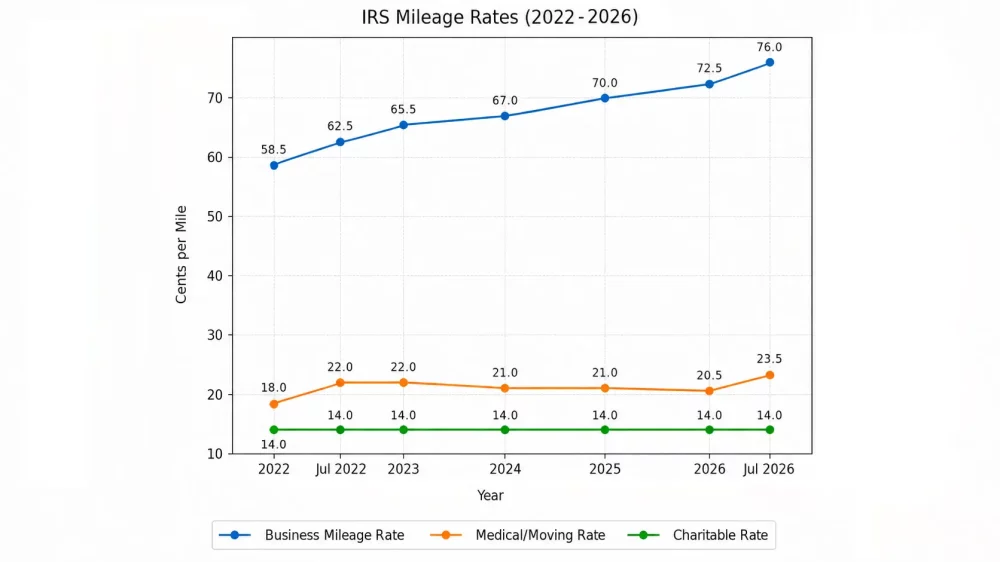
The IRS has announced a rare mid-year increase to the standard mileage rates for 2026. Beginning July 1, 2026, the business standard mileage rate increases from 72.5 cents to 76 cents per mile. The rates for eligible medical and moving travel also increase, while the charitable mileage rate remains unchanged.
The IRS says the adjustment reflects recent increases in fuel prices. Because the change took effect halfway through the year, taxpayers and businesses will need to use two different mileage rates when calculating eligible 2026 travel.
Table of Contents
Updated IRS Mileage Rates for 2026
The new rates apply to eligible mileage or vehicle expenses paid or incurred from July 1 through December 31, 2026.
The revised rates apply to qualified expenses incurred on or after July 1, 2026.
That means:
Business miles driven from January 1 through June 30 use the 72.5-cent rate.
Business miles driven from July 1 through December 31 use the new 76-cent rate.
The higher rate does not apply retroactively to trips taken during the first half of the year.
For employee mileage allowances, the IRS states that the revised rate applies when the allowance is paid on or after July 1 and relates to transportation expenses incurred on or after that date.
Why Did the IRS Increase the Rate?
The IRS normally sets standard mileage rates once per year. However, it may make an exceptional mid-year adjustment when driving costs change significantly.
According to Motus, this adjustment results from recent increases in fuel prices. The higher rate applies not only to gasoline and diesel vehicles, but also to electric and hybrid vehicles. Mid-year changes are uncommon, but they are not unprecedented. The IRS also raised the standard mileage rate halfway through 2022 following a sharp increase in fuel costs.
What Does the Increase Mean for Business Drivers?
The extra 3.5 cents per mile can add up for self-employed professionals, independent contractors, gig workers, and business owners who drive frequently. For eligible business mileage driven during the second half of 2026, the increase is worth:
$35 more per 1,000 miles
$175 more per 5,000 miles
$350 more per 10,000 miles
These figures represent an increase in the potential mileage deduction, not necessarily the exact amount saved on taxes. Actual tax savings depend on each taxpayer’s circumstances. Employers that use the IRS standard mileage rate to reimburse employees may also need to update their mileage reimbursement policies. The rate used should reflect when the travel expense occurred.
Accurate Trip Dates Matter in a Split-Rate Year
Because two rates apply during 2026, accurate trip dates are especially important. A single annual mileage total may not be enough to calculate the correct deduction or reimbursement. Drivers should be able to separate trips completed before July 1 from those completed during the second half of the year.
Keeping trips organized throughout the year helps prevent the first-half rate from being applied to second-half mileage—or the new rate from being incorrectly applied to earlier trips.
Keep Your 2026 Mileage Records Organized
MileageWise helps automatically record and organize trips by date, making it easier to separate mileage between the two 2026 rate periods. The mileage tracker app and web dashboard help drivers categorize business trips, manage mileage records, and create detailed, IRS-ready mileage reports. If trips from earlier in the year are missing, MileageWise also offers tools for rebuilding past mileage using available trip and location information.
With two mileage rates now applying during the same tax year, keeping a complete chronological mileage log can make deduction and reimbursement calculations much simpler.
Try MileageWise for free for 14 days. No credit card required!
No. The new rate applies to eligible expenses incurred on or after July 1, 2026. Trips taken before that date continue to use the original 2026 rates, which are 72.5 cents for business and 20.5 cents for moving and medical purposes.
To provide the best experiences, we use technologies like cookies to store and/or access device information. Consenting to these technologies will allow us to process data such as browsing behavior or unique IDs on this site. Not consenting or withdrawing consent, may adversely affect certain features and functions.
Functional
Always active
The technical storage or access is strictly necessary for the legitimate purpose of enabling the use of a specific service explicitly requested by the subscriber or user, or for the sole purpose of carrying out the transmission of a communication over an electronic communications network.
Preferences
The technical storage or access is necessary for the legitimate purpose of storing preferences that are not requested by the subscriber or user.
Statistics
The technical storage or access that is used exclusively for statistical purposes.The technical storage or access that is used exclusively for anonymous statistical purposes. Without a subpoena, voluntary compliance on the part of your Internet Service Provider, or additional records from a third party, information stored or retrieved for this purpose alone cannot usually be used to identify you.
Marketing
The technical storage or access is required to create user profiles to send advertising, or to track the user on a website or across several websites for similar marketing purposes.
To provide the best experiences, we use technologies like cookies to store and/or access device information. Consenting to these technologies will allow us to process data such as browsing behavior or unique IDs on this site. Not consenting or withdrawing consent, may adversely affect certain features and functions.
Functional
Always active
The technical storage or access is strictly necessary for the legitimate purpose of enabling the use of a specific service explicitly requested by the subscriber or user, or for the sole purpose of carrying out the transmission of a communication over an electronic communications network.
Preferences
The technical storage or access is necessary for the legitimate purpose of storing preferences that are not requested by the subscriber or user.
Statistics
The technical storage or access that is used exclusively for statistical purposes.The technical storage or access that is used exclusively for anonymous statistical purposes. Without a subpoena, voluntary compliance on the part of your Internet Service Provider, or additional records from a third party, information stored or retrieved for this purpose alone cannot usually be used to identify you.
Marketing
The technical storage or access is required to create user profiles to send advertising, or to track the user on a website or across several websites for similar marketing purposes.