









Home » Mileage Tax Deduction » IRS Standard Mileage Rates
Last Updated: July 17, 2026
Looking for the latest IRS mileage rate? You’ve come to the right place! We’ll break down the 2026 and 2025 mileage rates, explain who can use them, and show you how to maximize your mileage tax deduction. Whether you’re a small business owner, a freelancer, or a dedicated volunteer, understanding these rates is key to saving money.
The IRS updates its standard mileage rates each year, and 2026 brings some important changes. These rates cover the cost of operating a vehicle for business, charitable, medical, or moving purposes. Knowing them is crucial for proper tax planning and reimbursement.
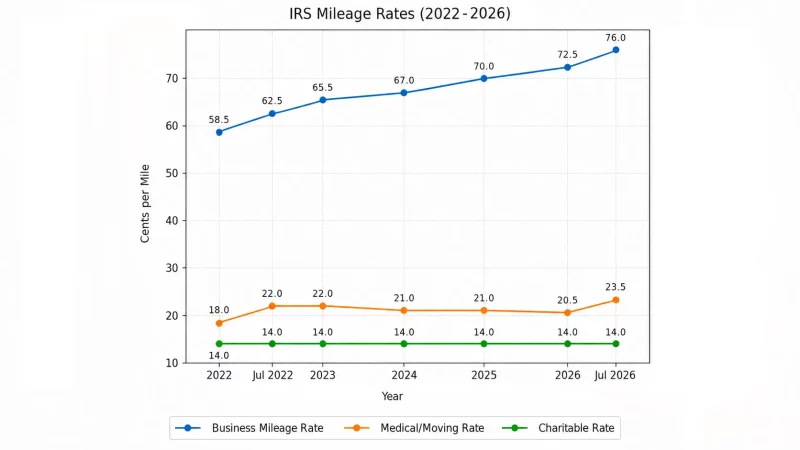
For 2026, the IRS first set mileage rates effective from January 1. It later announced a mid-year increase for business, medical, and qualified moving mileage to reflect rising fuel costs. The revised rates apply beginning July 1, 2026.
To give you a clearer picture, here’s how the 2026 IRS mileage rates compare with the 2025 rates:
| Purpose | 2025 Mileage Rate (January 1–December 31) | 2026 Mileage Rate (January 1–June 30) | 2026 Mileage Rate (July 1–December 31) |
| Business | 70 cents | 72.5 cents | 76 cents |
| Charitable | 14 cents | 14 cents | 14 cents |
| Medical / Qualified Moving | 21 cents | 20.5 cents | 23.5 cents |
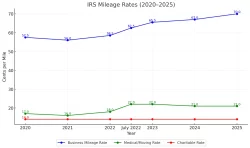
As you can see, the largest mid-year change is the business mileage rate, which rose by 3.5 cents per mile beginning July 1, 2026. The medical and qualified moving rate rose by 3 cents, while the charitable rate remained unchanged. See historical rates on the IRS’s website. Or check out this overview:
The business mileage rate covers the variable costs for vehicle operation, such as:
They also account for the following fixed costs for business vehicle operation:
The same tariffs apply to all passenger cars, including cars, vans, pickups, and panel vans. Note that the IRS mileage rates do not cover the cost of parking and tolls. They may be deducted separately. Furthermore, these rates are set federally, so they are the same amount throughout the U.S.
Here’s a video breakdown of everything you need to know about standard mileage rates.
The IRS mileage allowance is based on cost data and analysis that Motus compiles and sends out to the IRS. Motus uses data from the whole country and measures gas/oil prices, service costs, automobile insurance premiums, travel expenses, depreciation, and other costs included in operating and maintaining a car.
The IRS looks at several things when setting the mileage rates:
For charity purposes, the standard mileage rate is based on the minimum value established by federal law. It is meant to compensate taxpayers for expenses they usually pay out of their pocket and are not reimbursed for by anyone else but the IRS.
Understanding the IRS mileage allowance and eligibility is only half the battle. The other half, and arguably the more critical one for your tax return, is mileage tracking. An accurate and compliant mileage log is crucial to secure and maximize your mileage deduction.
This is where MileageWise shines.
Whether you’re new or prepping for tax time, our support team understands your needs. Expect fast, practical help — not endless response times or robotic answers.
Before MileageWise, mileage tracking was my biggest headache. As a DoorDash courier, I spent hours on the road but never had a reliable system to log my drives. I knew the 2026 IRS mileage rate could lead to big deductions, but my notes were scattered and my logs incomplete. Every April, I stressed over missed write-offs and dreaded the thought of an audit.
Then I found MileageWise. By importing my Google Maps Timeline history, I recovered unlogged trips from last year in minutes. I then started to use their app to never miss my miles again. Suddenly, mileage logging wasn’t a burden. Now I claim every mile with confidence, knowing I’m getting the deduction I deserve.
Understanding the IRS mileage rate is your first step. Turning that knowledge into significant tax savings requires action.
By leveraging the right tools, you can confidently claim your deductions and keep more of your hard-earned money.
For 2026, there are two sets of IRS standard mileage rates:
Fron January 2026 to June 2026:
Fron July 2026 to December 2026:
Business owners, self-employed individuals, and employees using their vehicles for work (but not commuting), qualified active-duty military for moving, and volunteers for charitable organizations can use the standard rates when reporting expenses on their tax returns.
The IRS mileage allowance covers fuel, oil, repairs, tires, maintenance, insurance, registration, and depreciation of your vehicle.
Yes. Taxpayers can choose to deduct actual vehicle expenses. This is beneficial if you have high expenses, as it may result in a larger deduction. You must choose one method per year, per vehicle.
Typically, the IRS updates the mileage rates yearly, but they have occasionally updated mid-year due to unusual fuel price fluctuations such as in 2022 and 2026.