
IRS Mileage Guide


Home » Mileage Tax Deduction » IRS Standard Mileage Rates
Last Updated: November 12, 2026
Looking for the latest IRS mileage rate? You’ve come to the right place! We’ll break down the current IRS mileage rate for 2026, explain who can use it, and show you how to maximize your mileage tax deduction.
We’ll also cover what we know about the IRS mileage rate 2027, which has not yet been announced. Whether you’re a small business owner, freelancer, or dedicated volunteer, understanding these rates is key to saving money.
TL;DR
- The 2026 IRS business mileage rate is 72.5 cents per mile from January through June and 76 cents from July through December.
- Medical and qualified moving rates also increased mid-year, from 20.5 to 23.5 cents per mile. The charitable rate remains 14 cents.
- The IRS mileage rate 2027 has not been announced yet. New rates are expected in December 2026.
- Accurate mileage logs are essential for claiming deductions. Track trip dates, distances, destinations, and business purposes.
- MileageWise helps you track trips automatically, recover missing mileage, and create IRS-ready reports. Try it free for 14 days!
Table of Contents
IRS Mileage Rates 2026 and 2027: Current Rate per Mile
The IRS updates its standard mileage rates each year, and 2026 brings some important changes. These rates cover the cost of operating a vehicle for business, charitable, medical, or moving purposes. Knowing them is crucial for proper tax planning and reimbursement.
For 2026, the IRS first set mileage rates effective from January 1. It later announced a mid-year increase for business, medical, and qualified moving mileage to reflect rising fuel costs. The revised rates apply beginning July 1, 2026.
Looking ahead, the 2027 mileage rate has not yet been announced. The new rates are expected to be published in December 2026, and we will update this article once the IRS confirms the official figures. Until then, the 2026 rates below remain the latest announced rates.
Mileage Rates From January 1 Through June 30, 2026
- Business use: 72.5 cents per mile – This rate is essential for self-employed individuals and small business owners looking to reduce their taxable income. It is intended to account for eligible business-related vehicle costs.
- Charitable purposes: 14 cents per mile – This rate is set by statute, meaning Congress would need to change the law for it to increase. Volunteers may be eligible to deduct qualifying drives for charitable purposes.
- Medical or qualified moving purposes: 20.5 cents per mile – Medical mileage may qualify in certain circumstances. Moving expenses are generally limited to eligible active-duty members of the Armed Forces and certain members of the intelligence community.
Mileage Rates From July 1 Through December 31, 2026
- Business use: 76 cents per mile – An increase of 3.5 cents per mile compared with the rate in effect from January through June.
- Charitable purposes: 14 cents per mile – This rate remains unchanged throughout 2026.
- Medical or qualified moving purposes: 23.5 cents per mile – An increase of 3 cents per mile compared with the first-half rate.
Comparing the IRS Mileage Rates of 2025 and 2026
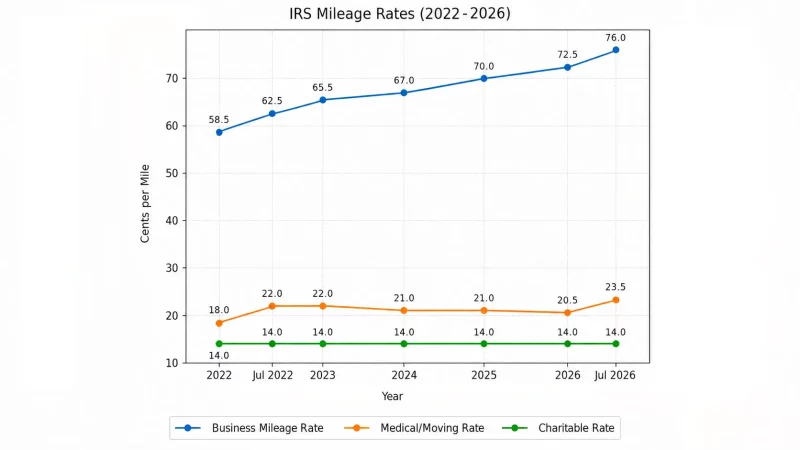
To give you a clearer picture, here’s how the 2026 IRS mileage rates compare with the 2025 rates:
| Purpose | 2025 Mileage Rate (January 1–December 31) | 2026 Mileage Rate (January 1–June 30) | 2026 Mileage Rate (July 1–December 31) |
| Business | 70 cents | 72.5 cents | 76 cents |
| Charitable | 14 cents | 14 cents | 14 cents |
| Medical / Qualified Moving | 21 cents | 20.5 cents | 23.5 cents |
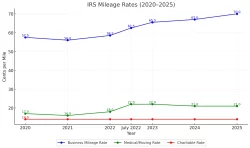
As you can see, the largest mid-year change is the business mileage rate, which rose by 3.5 cents per mile beginning July 1, 2026. The medical and qualified moving rate rose by 3 cents, while the charitable rate remained unchanged. See historical rates on the IRS’s website. Or check out this overview:
Try MileageWise for free for 14 days. No credit card required!
Automatic Mileage Tracker App


What 76¢ Per Mile Is Worth: Worked Example
The current IRS mileage rate for business travel is 76 cents per mile from July 1 through December 31, 2026. That means every 1,000 eligible business miles can generate a $760 tax deduction.
Here’s what that looks like at different mileage totals:
- 1,000 business miles: $760 deduction
- 5,000 business miles: $3,800 deduction
- 10,000 business miles: $7,600 deduction
- 20,000 business miles: $15,200 deduction
Remember, these amounts reduce your taxable business income, not your tax bill dollar for dollar. Your actual tax savings depend on your tax situation.
If you drove for business during both halves of 2026, calculate your deduction separately using 72.5 cents per mile before July 1 and 76 cents per mile from July 1 onward.
Who Can Use the Standard Mileage Rate for Business
The IRS standard mileage rate is primarily used by self-employed individuals and business owners who drive for work. Eligible taxpayers can deduct qualifying business mileage instead of calculating individual vehicle operating expenses.
Common examples include:
- Self-employed professionals: Freelancers, consultants, and independent contractors driving to clients or business meetings.
- Gig workers: Rideshare and delivery drivers using their personal vehicles for work.
- Small business owners: Entrepreneurs traveling between business locations, suppliers, and customers.
- Employees: Workers receiving mileage reimbursement from their employers, although most W-2 employees cannot deduct unreimbursed business mileage on their federal tax returns.
Qualifying medical travel, charitable driving, and certain moving expenses may also be eligible for mileage deductions at their respective rates. Some specialized employee categories qualify for exceptions.
Keep in mind that everyday commuting between your home and regular workplace generally doesn’t qualify as deductible business mileage.
What the Business Mileage Rate Covers and What You Can Still Deduct
The business mileage rate covers variable vehicle operating costs, such as:
- Gasoline
- Oil
- Tires
- Maintenance
- Repairs
It also accounts for fixed vehicle costs, including:
- Insurance
- Registration
- Depreciation
- Lease payments
The same standard mileage rate applies to eligible passenger vehicles, including cars, vans, pickups, and panel trucks.
Note that the IRS standard mileage rate does not include business-related parking fees and tolls. These may generally be deducted separately. However, you cannot also deduct gasoline, repairs, depreciation, or other operating expenses already covered by the standard mileage rate.
Because these rates are set federally, they apply throughout the United States, regardless of where you drive.
Here’s a video breakdown of everything you need to know about standard mileage rates.
The Mileage Log You Need to Claim the Business Mileage Rate
Knowing the mileage rate is only useful if you can prove how many eligible miles you drove. The IRS requires reliable records to support your business mileage deduction.
A proper mileage log should include:
- Date: When each business trip took place.
- Starting point and destination: Where you traveled.
- Business purpose: Why the trip was necessary for work.
- Miles driven: The distance traveled for business.
- Total mileage: Records supporting the vehicle’s annual business and personal mileage.
You can maintain your records manually or use an automatic mileage tracker to capture trips and organize them into an IRS-ready mileage log.
Accurate recordkeeping is especially important in 2026 because business miles driven before and after July 1 must be calculated using different rates.
How the IRS Sets the Federal Rates
The IRS mileage allowance is based on cost data and analysis that Motus compiles and provides to the IRS. Motus uses nationwide data to measure fuel prices, maintenance costs, automobile insurance premiums, depreciation, and other expenses associated with operating and maintaining a vehicle.
The IRS considers several factors when setting the mileage rates:
- Fuel prices and vehicle fuel efficiency
- Vehicle depreciation
- Insurance costs
- Maintenance and repair expenses
The charitable mileage rate is different because it is fixed by federal law rather than adjusted annually based on vehicle operating costs. It remains 14 cents per mile unless Congress changes the law.
IRS Mileage Rates vs GSA Government Mileage Rate
The IRS and the General Services Administration (GSA) publish mileage rates for different purposes, but their standard automobile rates are closely connected.
The IRS mileage rate helps eligible taxpayers calculate vehicle-related deductions and provides a benchmark for business mileage reimbursement. The GSA mileage rate determines reimbursement for federal employees using privately owned vehicles for official government travel.
From July 1 through December 31, 2026, both use a standard automobile rate of 76 cents per mile. However, GSA also provides separate reimbursement rates for situations such as using a personal vehicle when a government-owned vehicle is available, as well as motorcycle and airplane travel.
As for the government mileage rate 2027, the official figures have not yet been announced. The federal mileage rate 2027 for standard automobile travel is expected to follow the IRS business mileage rate, consistent with federal reimbursement rules.
You can find the latest government reimbursement rates on the official GSA website.
How to Secure Your Mileage Deduction With Accurate Records
Understanding the IRS mileage allowance and eligibility is only half the battle. The other half, and arguably the more critical one for your tax return, is mileage tracking. An accurate and compliant mileage log is crucial to support and maximize your mileage deduction.
This is where MileageWise shines.
Mobile App for Effortless Mileage Logging
- Smart Auto-Tracking: Capture every drive automatically with customizable tracking options.
- Ad-Free & Privacy-First: No distractions or worries. Your data stays yours, and your app stays clean.
- Reliable Trip Start Detection: Our backup system ensures the start of every drive is logged, even though other apps often miss it.
- Custom Route & Distance Options: Choose between actual routes or optimized distance calculation.
Web Dashboard for Missed Mileage
- Google Timeline Import: Bring in your Google Maps Location History to automatically recover trips you forgot to track.
- Advanced Trip Management: Organize, filter, and edit trips in bulk, set custom categories, and set recurring trips with ease.
- Bulk Trip & Client Import: Upload entire client lists or import routes all at once. Perfect for busy professionals managing recurring drives or large fleets.
Try MileageWise for free for 14 days. No credit card required!
Automatic Mileage Tracker App
A Courier’s Success Story with MileageWise
Before MileageWise, mileage tracking was my biggest headache. As a DoorDash courier, I spent hours on the road but never had a reliable system to log my drives. I knew the 2026 IRS mileage rate could lead to big deductions, but my notes were scattered and my logs incomplete. Every April, I stressed over missed write-offs and dreaded the thought of an audit.
Then I found MileageWise. By importing my Google Maps Timeline history, I recovered unlogged trips from last year in minutes. I then started to use their app to never miss my miles again. Suddenly, mileage logging wasn’t a burden. Now I claim every mile with confidence, knowing I’m getting the deduction I deserve.
Summary and Final Steps
Understanding the IRS mileage rate is your first step. Turning that knowledge into significant tax savings requires action. By leveraging the right tools, you can confidently claim your deductions and keep more of your hard-earned money.
FAQ
What are the IRS mileage rates?
For 2026, there are two sets of IRS standard mileage rates:
Fron January 2026 to June 2026:
- Business use: 72.5 cents per mile
- Medical or moving purposes: 20.5 cents per mile
- Charitable organizations: 14 cents per mile
Fron July 2026 to December 2026:
- Business use: 76 cents per mile
- Medical or moving purposes: 23.5 cents per mile
- Charitable organizations: 14 cents per mile
What is the mileage rate for 2027?
The 2027 IRS mileage rate has not yet been announced. The IRS typically releases new rates in December of the preceding year, although announcements occasionally come in January.
The business mileage rate has generally trended upward in recent years, while medical and moving rates have fluctuated. The charitable mileage rate is expected to remain at 14 cents per mile, as it is fixed by federal law and can only change through legislation.
Who can use the IRS standard mileage rate?
Business owners, self-employed individuals, and employees using their vehicles for work (but not commuting), qualified active-duty military for moving, and volunteers for charitable organizations can use the standard rates when reporting expenses on their tax returns.
What expenses does the IRS mileage rate cover?
The IRS mileage allowance covers fuel, oil, repairs, tires, maintenance, insurance, registration, and depreciation of your vehicle.
Can I claim actual vehicle expenses instead of the standard mileage rate?
Yes. Taxpayers can choose to deduct actual vehicle expenses. This is beneficial if you have high expenses, as it may result in a larger deduction. You must choose one method per year, per vehicle.
How often does the IRS update the mileage rates?
Typically, the IRS updates the mileage rates yearly, but they have occasionally updated mid-year due to unusual fuel price fluctuations such as in 2022 and 2026.